
Set Your Dolly Free: Flyka Glides In
People who use swans as a metaphor for grace being driven by hidden exertion must never have visited a film set. The amount of stuff going on behind the camera and dangling over actors’ heads gives little clue about the polished finished product. Inside the industry, though, the quest to simplify the back end has been an ongoing one, the cameras themselves being a case in point. Static scenes are simple enough – just mount a camera and you’re away. And moving along a straight line can be done using rails. But when it comes to filming things that are moving from a close perspective or where rails cannot be put down, the results can be unconvincing or unintentionally amusing.
Here is Audrey Hepburn “riding” a scooter in Roman Holiday.
Convinced that she’s riding on the camera-facing shots? Look at the reflection in the window in this scene from Pulp Fiction (30 seconds in), and you’ll see what’s happening.
And it’s not just the avoidance of bloopers that directors worry about. Some scenes they would love to film in a certain way are just impossible without a nimble camera mount. And that’s exactly where Flyka rolls in. Because they’ve cracked it.
Flyka design, build and drive a new breed of electric mobile platforms that are set to liberate directors’ ambitions when it comes to filming moving subjects. With their minimum crew of two, they allow a driver and a camera operator to work together to follow or lead moving subjects. The near-ground platform lets the camera operator step on and off as required, even when the vehicle is in motion; with a steadicam the transition will be seamless. But because of the dollies’ maximum load of 70 stone (444 kg), they can actually carry a crew of four plus their equipment. That means a sound recordist can join them, an option that’s finally open thanks to the super-quiet electric motors.
The idea came to cameraman Tony Holker, founder of Flyka, when he saw just how versatile modern mobility scooters had become. Battery life was no longer an issue for practical purposes, and the machines themselves were capable of some pretty impressive speeds and had a surprising ability to cope with various terrains, gradients and surfaces.
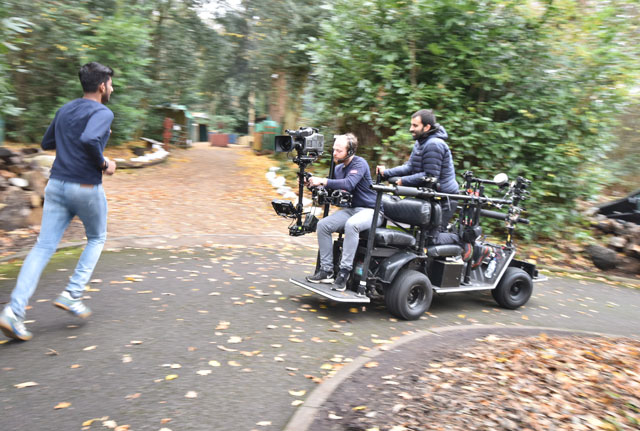 Tony set to work building his prototype. But the #1 dolly product proved not to be a prototype for long after he started hiring it out to satisfy the eager producers beating a path to his door. Before long he had used his invention to film people cycling, ice skating, skateboarding and running with a speed and smoothness that had hitherto been impossible.
The ice skating in particular was something of a coup. One of the TV dramas being filmed right here at The Sharp Project had a scene set in a skating rink, with the two characters (neither of whom could skate) needing to be filmed close up. After some head-scratching, the producer got a lead that there was a company in Belfast that might be able to help, and when he visited he was told that they should try out a new company based in Manchester. The producer asked for the whereabouts and found out that the solution had been right under his nose all along. Together Flyka and the crew constructed a trailer and for the waist-up motion shots filmed them from the back of the dolly, and the results were stunning.
Since then, Flyka have built another four machines and scrapped the original three, but the remaining two are both in regular demand from directors looking for the perfect way to film. But Tony sees the potential to be much larger. He has a patent pending on his design, and has a brand new design waiting for construction that takes advantage of everything he has learnt from his first two and is better suited to quite harsh terrain. He has also gained enough data to be able to custom-build dollies for particular tasks at the request of TV and film companies.
This is why Tony sees his next challenge not as technical but commercial. He’s looking for investors to help him take his plans forward and realise the incredible potential of his invention. The business model he’s using at the moment is a service model, hiring out the driver (one of whom is Tony) and the machine itself, but with growth that will clearly not be possible, which is why some active investors could unleash Flyka on the world.
But for now, Tony is happy with his business and is excited by the interest already shown. In true start-up style his marketing budget has been limited, but interest has been relentless thanks to word of mouth recommendations, Tony’s contacts in TV and cinema and a little online promotion. Anyone who attended The Sharp Project’s opening will have seen Tony and his dollies filming the crew of skateboarders and BMXers doing their thing from angles that would have been impossible before Flyka came into being. The camerafolk were actually filming that night – those cameras were loaded; we’re hoping to put a little montage together soon.
Flyka looks like it’s going to be the sort of business that directors and producers will have on speed dial because it’s the missing link between hand-held camerawork and rolling on rails. And if you’re really nice to Tony, he might even let you have a go.
LATEST BLOG POSTS
-
 Jan 01
Vacancy: Senior Videographer – Marick
-
 Jan 01
Vacancy: General Manager – Sick! Productions


