
Full Circles, Square Containers: Garrett, Saville & Sharp
Two 1970s graphic design contemporaries overcame the Manchester drizzle and went on to influence the music industry in quite different ways over the following decades. Now The Sharp Project has brought them back together to help shape the city’s entrepreneurial future.
British musical graphics from the 1970s to the 2000s would look very different without the input of two notable figures, Peter Saville and Malcolm Garrett. If the former took the dark, sardonic and thoughtful autobahn occupied by the likes of Joy Division and New Order, the latter was cruising the boulevard, creating upbeat, energetic visuals for the Buzzcocks and then Duran Duran, Simple Minds, Magazine, Culture Club and their ilk. It’s pointless trying to debate which one epitomised his time the most; creatively, it was a time of flux from which popular culture has never re-settled.
The fact that Saville and Garrett are now collaborating on The Sharp Project’s concept is interesting enough. Perhaps you could imagine a clash of mindsets with either a fuzzy compromise emerging or one of them being squeezed out. But neither of those scenarios would be at all interesting, except for being somewhat out of character. What makes the coming together of these two epitome artists worthy of note is that they have a bit of previous.
Imagine, if you will, mini Malcolm and mini Peter – short trousers, muddy knees, catapults, studiously cocked school caps and lashings of inner creative torment – being schoolmates in sixties/seventies Britain. The school in question was St Ambrose College, Altrincham, where they were indeed friends. The next stop was Manchester Polytechnic; our duo were contemporaries in what was to prove a golden intake of 1975, studying graphic design in an age when macs existed merely to keep the Manchester downpours off students’ coursework.
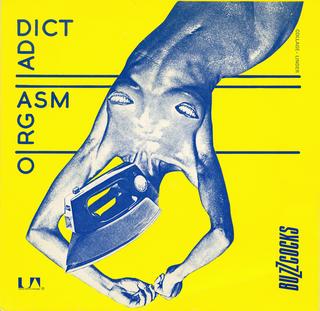 The first to benefit were Buzzcocks, whose original front-man Howard Devoto and Garret had a mutual friend, Linder Sterling. Garret helped Linder with the sleeve art for Orgasm Addict, Buzzocks’ second single. It became his first published musical artwork, and the red leather jacket he bought with his £100 pay cheque entered Manc folklore. Best of all, Buzzcocks decided to retain Garrett’s services.
As this was going on, Saville was enviously eyeing another prize. He approached Tony Wilson at Factory, enthusing about his beloved German Expressionism, which he knew Wilson also loved. After putting in the hours in the cause of punk, Wilson was seeing a non-Factory band from Manchester become the city’s first punk success, and desperately wanted a piece of the action. Wilson and Saville hit it off and straight away Factory had the missing element in pop success: a sleeve artist who fitted the label’s philosophy. Most aficionados set the Factory clock from this point, when the élan of Wilson, the imagery of Saville and the nous of Alan Erasmus fused into a force whose output and ethos are quintessentially Factory.
 Garrett’s career would go on to tread a different path. After Devoto left Buzzcocks and formed Magazine, he continued to hire Garrett for sleeve art, but Garrett’s work did not remain exclusively punk or post-punk. He founded his own design studio, Assorted Images, and went on to produce many a memorable sleeve that remain iconic examples of 80s music art. The artwork to Duran Duran’s Rio springs immediately to mind, that deceptively glamorous Patrick Nagel print somehow having even more eighties spirit injected into it by Garrett’s deft hand.
And just as music never stands still, neither did Garrett and Saville. The resolutely square 12- and 7-inch sleeve art that gave life to their inner black circles waned in importance in the age of CDs and ultimately mp3s; and these two creative types always had designs on the wider world anyway. Studios were founded and closed down, London and North America were conquered, and the music, retail and fashion industries sent their Garrett and Saville designs straight into the collective subconscious. Outside the field, there are few household-name graphic designers, but a world without the St Ambrose alumni would have a very different look and feel.
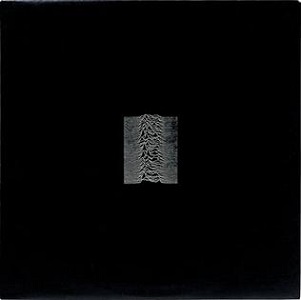 So there’s a certain roundness about the fact that they’re back together on The Sharp Project, even though a tuning fork pattern might have been more resonant. Both men have the ideas and the experience and have never for a moment taken their fingers off the pulse of technological and creative progress. This isn’t a dual comeback; it’s not Take That; nor is it Ian Curtis on a yacht. It’s just two steps in two fascinating careers that are happily coinciding for the good of a project both Saville and Garrett believe in wholeheartedly.
The location of the collaboration could not be more apt, either. The building was once occupied by Sharp Corporation, Japan’s oldest technology company, whose first product, the ever-sharp mechanical pencil, gave the company its name at the start of the 20th century. The building has design in its DNA and the environment is ripe for evolution … or at least a little intelligent design.
LATEST BLOG POSTS
-
 Jan 01
Manchester Launches New Quarterly Film and Video Event: “REC:MCR – Northern Networking”
-
 Jan 01
Vacancy: Senior Videographer – Marick


